
Collective campaign
The final push to protect 32 hectares in the Lluçanès
Emprius de les Vinyes now belongs to Fundació Emprius: 32 hectares moving from agribusiness to biodiversity, small-scale farming and the commons. One last collective push remains: €25,000 to complete the purchase. Donations are tax-deductible up to 80%.
Campaign progress
0 € of 25,000 €
25,000 € to goThe campaign has just started — be the first person to contribute!
- 32 haof fields and woodland in Sant Martí d’Albars, in the Lluçanès
- 30 yearsof commitment to conservation and regeneration
- €25,000still needed to complete the purchase
- 80%of tax relief (on contributions up to €250)
Why your contribution matters
Thanks to support from the Natural Heritage Fund, contributions from Fundació Emprius and Mas Les Vinyes, and years of work, we have bought a 32-hectare property in Sant Martí d’Albars, in the Lluçanès, which until now was in the hands of industrial agriculture. We are giving it a new name: Emprius de les Vinyes.
The property cost €340,277. To cover the remaining cost and all purchase expenses, we need €25,000 more. Each contribution is a donation to a non-profit foundation, and brings us closer to the real work: restoring heavily degraded soils, opening management to the local community, and producing agroecological food.

What is the property for?
- Ecological restoration: bringing the soil back to life and building biodiversity.
- Useful knowledge: measuring and sharing what works for restoring degraded soils.
- Agroecological production: organic food for local worker and farming co-operatives.
- Shared communal uses: firewood and pasture managed with the local community.
How does a contribution work?
Choose your amount and how to pay. Say how much you would like to give and pick credit card (secure payment through Stripe) or bank transfer.
Complete your contribution. By card, you pay directly on Stripe. By transfer, you send the money to the foundation’s account and fill in a short form with your details.
Claim the tax relief. At the end of the year we’ll send you a digital donation certificate so you can claim tax relief on your tax return.
Frequently asked questions
How much should I contribute?
Whatever you like, from €5: you choose it in the contribution box, and you can pay by credit card or bank transfer.
Will I be able to claim tax relief?
Yes. Contributions are donations to a non-profit foundation and qualify for the tax relief described above. You’ll get a digital donation certificate at the end of the year.
What guarantees the property will be looked after?
Support from the Natural Heritage Fund means a commitment to a 30-year conservation, protection and biodiversity restoration project. The foundation wants to guarantee this for the indefinite future, with stewardship in the hands of the Mas Les Vinyes co-operative.
Can I get involved in another way?
Yes: you can become an Emprius member with an annual contribution, or find out about other ways to get involved.
Make your contribution
We do not store any bank or personal details on this website.
Tax-deductible: 80% relief on the first €250 you contribute.
Campaign progress
0 € of 25,000 €
25,000 € to goThe campaign has just started — be the first person to contribute!
The project in detail
The property
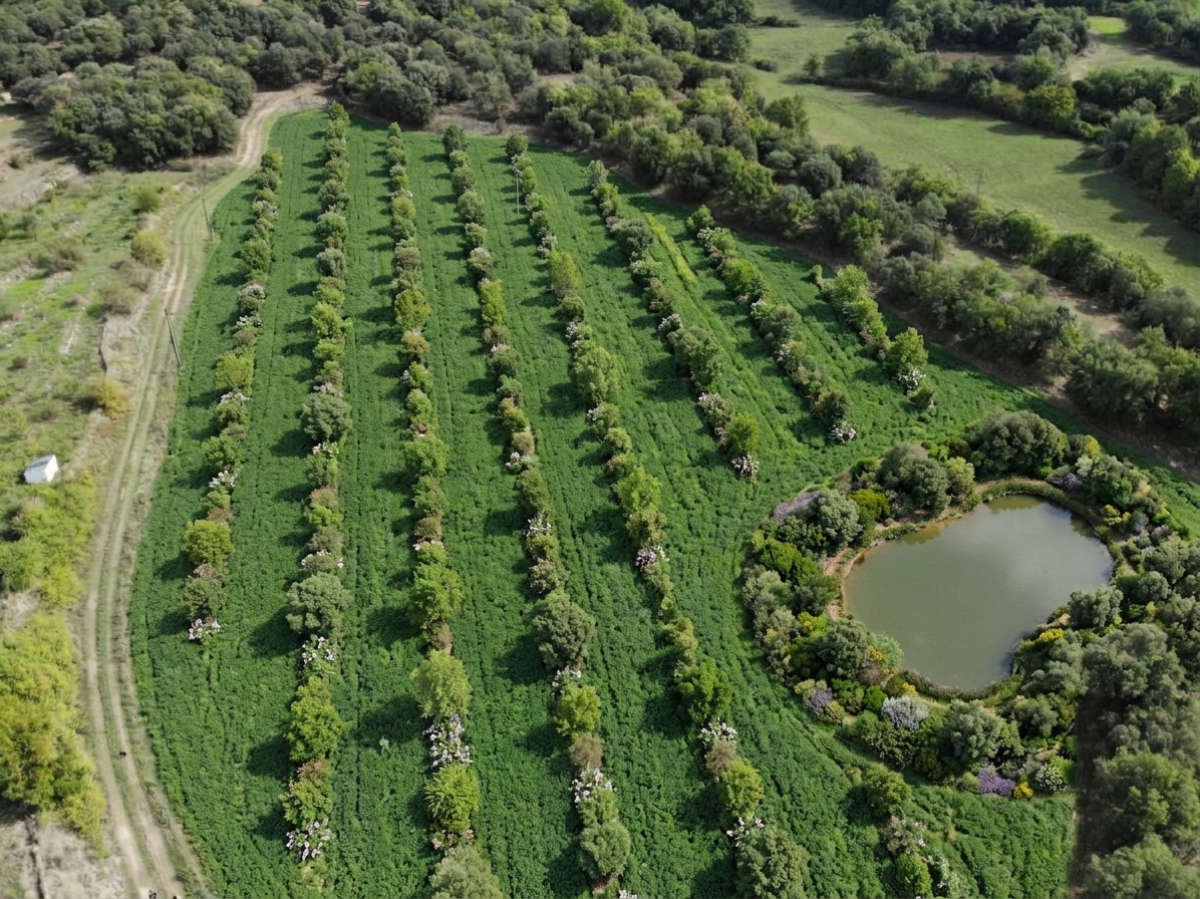
Of the property’s 32 hectares, 10 are fields, around 10 woodland and the rest exposed bedrock. It borders several agroecological farms, including Mas Les Vinyes, La Font Sostenible and Torrents, and with this purchase we can restore a wildlife corridor free of pesticides and herbicides.
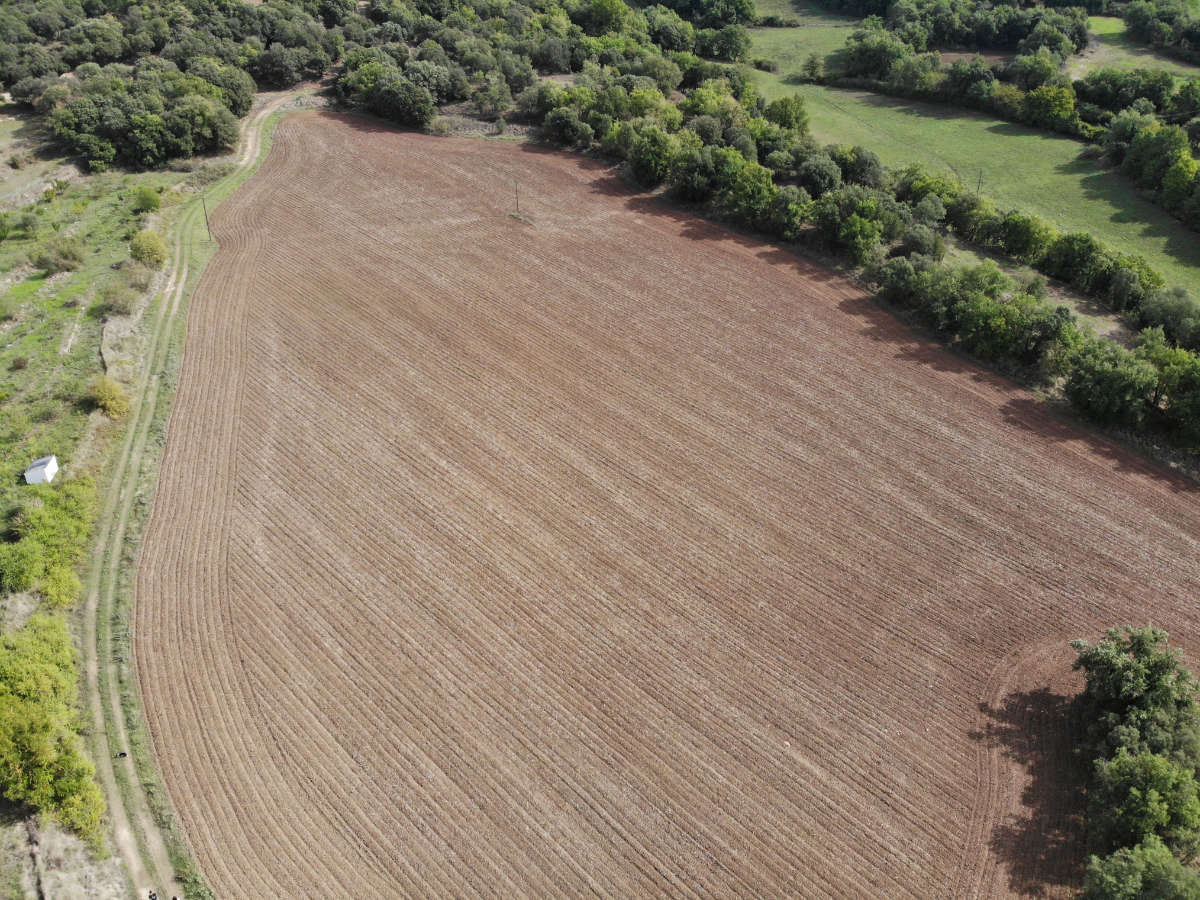
The soil here is currently severely degraded, due to the farming methods used until now. It contains just 1.3% organic matter, making it biologically dead soil, with heavy erosion and a tendency to desertification. That’s why we need to roll up our sleeves and restore it using permanent cover crops, agroforestry systems, water management design, biofertilisers and everything else within our reach.
The project
Through the following four pillars, we explain how we want to put the property to work for biodiversity, the common good, small-scale farming and the people of the region:
1) Ecological restoration
The main aim of the purchase is to protect and restore a property that comes from industrial pig farming, so the soil is currently heavily compacted, saturated with nitrates and severely degraded by herbicides and pesticides. With this project we want to restore soil fertility and water-holding capacity, restore different habitats and create new ones by increasing biodiversity, integrate farming, livestock and forest management…
2) Generating useful knowledge
We will monitor what we do and what works best to restore degraded soils: different green manures, avoiding heavy soil ploughing, agroforestry systems or livestock. We will measure and document it, sharing the knowledge gained from the processes we move forward at the property so it can be useful and replicable for restoration, agroecological production and balanced land management elsewhere.
To this end, we will seek involvement of different actors in monitoring the project so learning can extend far beyond Les Vinyes: universities, research centres, wildlife groups and regenerative farming networks… So far, we have spoken with CREAF (Ecological Research and Forest Applications Centre), Centre Tecnològic Beta (Biodiversity, Ecology, Environmental and Food Technology), the University of Vic and EARA (European Alliance for Regenerative Agriculture).
Securing ownership and the framework for use long term makes this a case of special interest for research and monitoring.
3) Agroecological production
We want the property to support productive projects by small-scale farmers in the region working to agroecological standards. The property has 10 hectares of sloping fields, hectares of exposed bedrock and a forest that has not been used for years and poses a fire risk because it has no firebreaks, fallen-tree clearance, etc.
At Emprius de les Vinyes, organic food will be produced through regenerative agriculture for local worker and farming co-operatives: grains — potentially cereals or pulses — fruit and/or vegetables, as well as meat and honey.
4) Shared communal uses of firewood and pasture
The property has approximately 15 hectares of forest. For the firewood and pasture uses for agroecological herds, we want to open management to the local people of the area. So that decisions can be made collectively, costs shared, collective workdays contributed and the firewood and land shared out — all while respecting the sustainability and regeneration principles of the project.
The management and shared harvesting of timber and pasture has been a widespread traditional communal practice in rural areas.
The numbers
The purchase was made possible by a grant for buying land containing habitats of community interest from the Natural Heritage Fund, aimed at non-profit organisations. The grant commits us to a 30-year conservation, protection and biodiversity restoration project, and we want to guarantee this not only for those 30 years but in perpetuity.
To cover the remaining €25,000, we have launched this campaign: “Emprius de Les Vinyes: protected property to regenerate in the Lluçanès!”.
| Item | Amount | Percentage |
|---|---|---|
| Contribution from the Natural Heritage Fund | 270,277 € | 79.4% |
| Contributions already secured | 45,000 € | 13.2% |
| Campaign goalThe challenge we want to reach with your contribution | 25,000 € | 7.3% |
| Total | 340,277 € | 100% |
Regenerative agriculture and permaculture
All the work we will undertake at the property is based on the principles of regenerative agriculture and permaculture. These two disciplines (one rooted in food production, the other in the design of human systems) let us see how restoration and production can go hand in hand.
Regenerative agriculture focuses on bringing soil back to life. By using practices like avoiding heavy ploughing to keep soil structure intact, adding green manures, growing cover crops and integrating livestock holistically, we increase organic matter, restore fertility and multiply the soil’s water-holding capacity. It transforms land degraded by industrial farming into fertile, resilient ecosystems.
Permaculture gives us the design framework to integrate the different elements of the property (the forests, the fields, the pasture, the water and human infrastructure), copying the patterns and relationships found in nature. That way, every element serves multiple purposes and the waste from one process becomes the resource for another.
Why “emprius”?
Today, the term “empriu” is not widely known. It refers to a resource for which some form of communal use or harvesting right exists. In other words, a resource that the people of a region have access to because of their status as local inhabitants.
It is part of a legacy of language connected to communalism that inspires us at Fundació Emprius, and this is why we want to rescue and reinvent it.
Over the centuries, and varying by region, there were different circumstances around rights, ownership and resource use. This entire legacy is part of what is known as popular “customary law”, based on “uses and customs”, which generally honoured the basic needs of the land and the people when setting social rules and agreements.
For centuries, communal assets and rights mattered enormously for the survival of rural communities. In many places there are place names called empriu, many of which have ceased to be associated with communal use, leaving only the name as a trace.
That is why we are giving the property this new name. Because so many communal assets and emprius have been lost. In some cases, we still have traces of the names in place names, but mostly they have become entirely private land.
We are promoting new and old emprius, working to spread communal culture and practice!
The third property acquired by the foundation
Last year Fundació Emprius announced the purchase of two other properties in rural Catalonia: Cal Cisteller and Can Gínjol.
The first, in the Alt Penedès, includes housing and supports an Ateneu Rural project. The second, in the horta of Lleida, also includes housing and infrastructure to host local grassroots groups and popular movements.
With this third purchase, the Foundation continues to prove itself a useful tool for acquiring and protecting heritage, putting it to work for transformative projects with positive social and environmental impact.
You can also become a member of Emprius
If, in addition to making a donation to this campaign, you want to become a member of Emprius with an annual donation, you will join the social base that ensures the tool the Foundation aims to be stays sustainable and can keep driving many more projects forward!