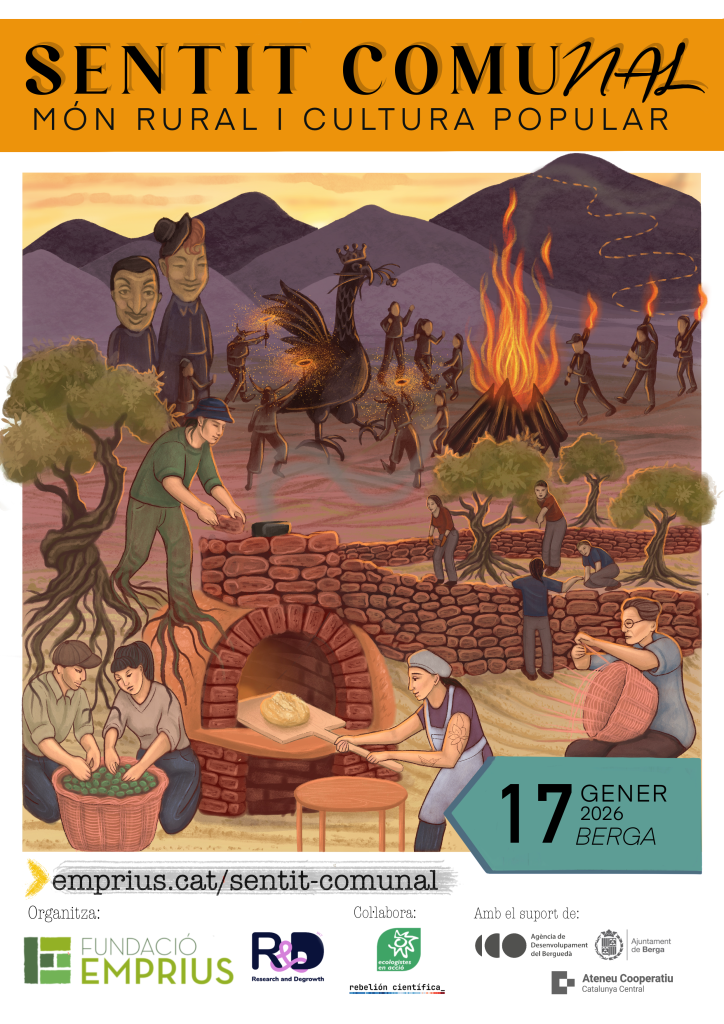
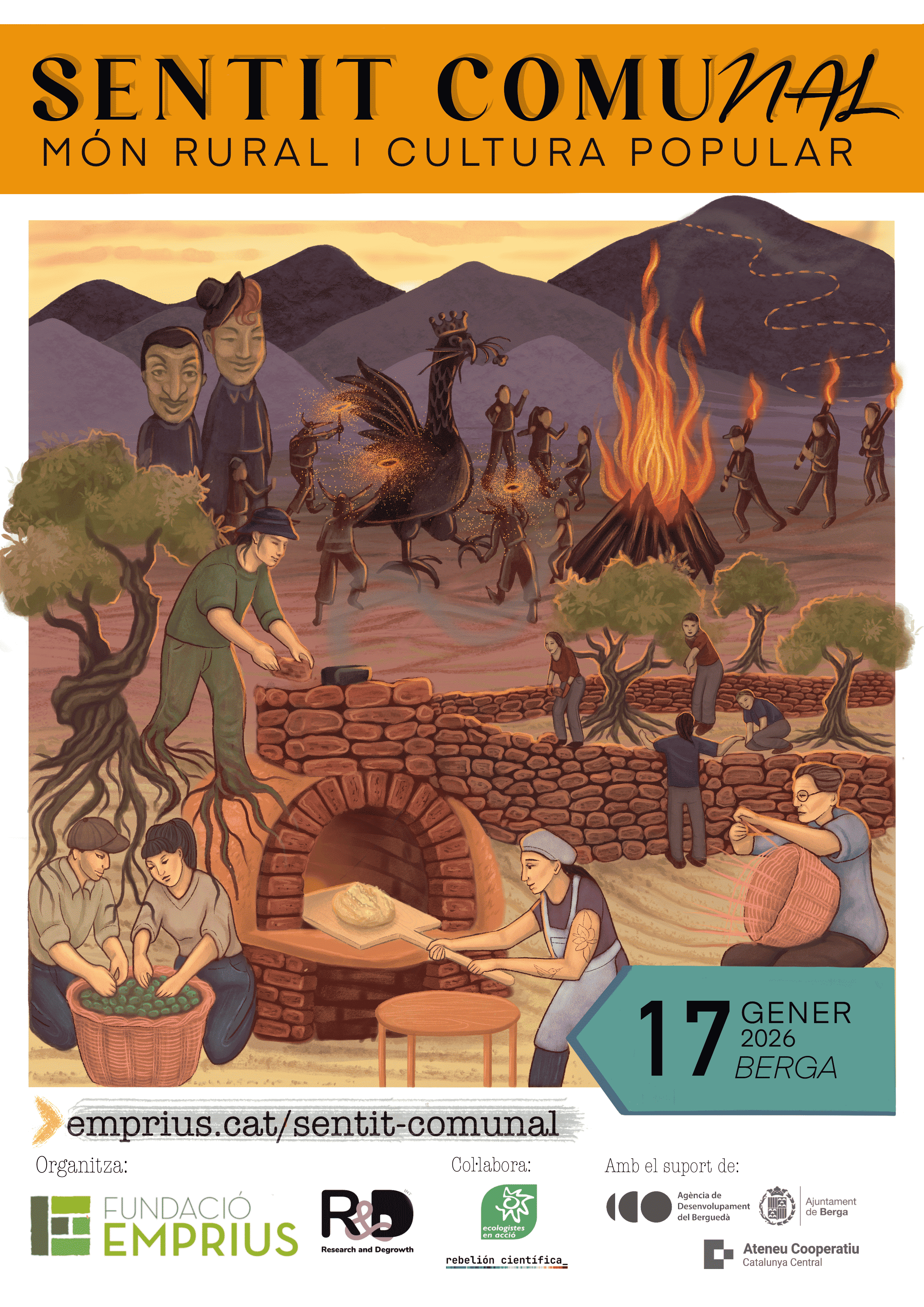
From Fundació Emprius –with the collaboration of Research & Degrowth, Ecologistas en Acción and Rebelión Científica–, we present the second edition of the congress “Sentit comunal”, this time focused on the theme “Rural world and popular culture”. It will take place in Berga on Saturday 17 January 2026.
It will touch on questions like village self-government through neighbourhood assemblies, trades and know-how, forms of communal work, projects for passing on knowledge, and festivity and celebration — and we’ll put it all into practice with workshops.
“Sentit comunal” is an initiative co-led by Fundació Emprius and Research & Degrowth to promote spaces for reflection on communalism and degrowth as much-needed perspectives for social transformation.
You can find the timetables, talk details, locations and much more in the dossier.
Congress videos available:
youtube.com/playlist?list=PLVJu8ajogipq7f22QMjQcNhp-gTDoHlpY

Joel Baró Mas
Resident of Lladrós (Pallars Sobirà)
Neighbourhood assembly, village self-government
Biography
A resident of Lladrós (Pallars Sobirà), connected to the social fabric and knowledgeable about communal arrangements in the Vall de Cardós, he has participated in different initiatives in his region valuing communal organisation as a neighbourhood tool for governing resources in Pyrenean villages. He currently serves as mayor of Vall de Cardós as a member of an electoral grouping.
Most of the municipal territory comprises communal assets, regulated by the municipal ordinances governing their use and exploitation, recognising the role of the neighbours’ commons in their management.

Alba Rivas Fernández
Commoner and activist (Galicia)
Biography
Commoner and president of the Cabenca-Revolta community of montes veciñais en man común (communal woodlands) in Galicia. An active collaborator with several local associations (Alarma Na Terra de Montes and others). She occasionally takes part in the Brigadas Deseucaliptizadoras, volunteer eucalyptus-clearing brigades. She considers herself a foliadeira and an aldeanista.
Involved in the Rede de Áreas Conservadas por Comunidades Locais, which recently published the “Atlas de áreas conservadas por comunidades locales”.

Anna Sínia
Basket maker and weaver
Works for the dissemination and preservation of ancestral knowledge, in favour of maintaining a symbiotic relationship with the territory.
Biography
Basket maker and weaver in plant fibres, co-creator of the Associació Terra de Mans, which worked on rural development and the recovery of old trades. She works to share and preserve ancestral knowledge, in favour of keeping a symbiotic relationship with the land. She uses basketry as a tool for social transformation, collaborating with mental health associations for a psychiatry that respects people.

Miguel Berbel Sánchez
Farmer and trainer
Biography
He participated in rural and peri-urban collectives such as Bajo el Asfalto está la Huerta! and Los Apisquillos, an advocate of non-specialisation, at home with farming, livestock and carpentry work (and all kinds of processing and making) within agroecological networks. He combines agricultural activity with training work.
He has written “La guadaña moderna. Picado, afilado y técnica de siega. Posibilidades autogestionarias en la pequeña y mediana escala”; “Afilado manual de herramientas varias” and “Apuntes agrícolas. Nuestra práctica en las huertas colectivas de autoabastecimiento. Hacia la autonomía alimentaria, horticultura anticapitalista”.

Jasone Mitxeltorena Ozkaritz
Researcher and writer
Biography
A researcher into the deep roots of our culture(s), which led her to take part in the Auzolan initiative; she is the author of the book “Auzolanaren kultura. Iraganaren ondarea, orainaren lanabesa, etorkizunaren giltza” (The culture of Auzolan. Legacy of the past, tool of the present, key to the future).

Ateneu Rural cal Cisteller
Community project
Biography
A space linked to a network of farmhouses, organisations and people in the Penedès that has for years fostered mutual aid and “a tornallom” community work days, moving towards communal rural self-sufficiency. The property was bought through a collective process, with Fundació Emprius as the legal owner, granting a lifelong right of use.

Escola Orígens
Ecological building workshop school (la Garrotxa)
Biography
A training and social action centre promoting knowledge of different building techniques and materials suited to construction that respects the environment and all living beings involved. A workshop school open to everyone, professionals and non-professionals alike, who wish to engage with ecological building, and especially to young people, with the aim of building a strong foundation for society’s future generations. It is located in Les Planes d’Hostoles (la Garrotxa).

Escuela de los Pueblos
School of rural self-management (Burgos)
Biography
A training and experiential space with two main aims: training promoters of rural life who support the revitalisation and defence of our territories, and creating a training space for the social movement that strengthens links between rural and urban settings. It will offer technical training in agroecology and fruit growing, extensive livestock farming, forest management and trades like carpentry, construction, ceramics and blacksmithing, as well as community health and social communication, always with a community approach: done by and for the village.

L'Atelier Paysan
Peasant workshop (France)
Biography
L’Atelier Paysan (France) provides support to farmers in the design and manufacture of machinery and buildings adapted to peasant agroecology. By bringing producers back into decisions about farm equipment, we collectively recover technical autonomy. By analysing the factors that bind us to the industrialised agricultural system, a system in which public policies and private interests constrain us, we empower ourselves to transform our land and our food system.

Berguedana de Folklore Total
Cultural association
Biography
An association dedicated to recovering, studying and sharing traditional music and dances from the Catalan Countries, with a focus on the Berguedà region. A group of music and traditional dance enthusiasts, we share our repertoire with anyone who wants to listen and dance. From the funds raised through their activities, they promote the publication of books preserving local popular culture.

Museu Comarcal de Berga
Municipal venue
Biography
The Museu Comarcal de Berga is the city’s cultural tourism hub, open to visitors and local people alike. It organises visits to the Casa de la Patum, where you can see the parade groups of this iconic Berga folk festival.


Sharing kitchen and table is also popular culture. This time Casal Panxo and Cal Blanxart will cook us a community paella with vegetables and mushrooms.
You can pre-book your lunch ticket by filling in this form before 11 January and pick the tickets up first thing on the day of the congress.
The congress is organised with people and collectives from across the peninsula, and the talks gather experiences from different parts of the territory.
The day will run in a mix of Catalan and Spanish, with translation from Catalan into Spanish for those who cannot understand Catalan. The translation service will be provided by COATI.
There will be a play area inside the theatre building. There will be no childcare service.
Hours: 10am–5.30pm.
As in many rural villages, public transport in Berga is limited.
We have set up a shared document so attendees can share information and find others travelling the same route.
On this map you’ll find some useful places for attending the congress:
- Teatre de Berga (main venue)
- Sala dels Castellers, space for the community meal
- Casal Cívic community hub, space for workshops
- Casa de la Patum
- Car parks
- Accommodation
Map of congress venues
Teatre de Berga, Sala dels Castellers, Casal Cívic, Casa de la Patum, car parks and accommodation, marked on an interactive Google My Maps map (opens in a new tab).
You can also find Berga on OpenStreetMap.