Fundació Emprius’s Board of Trustees is made up of founding people and organisations who watch over Emprius and ratify the strategic decisions that help us grow.

Ana Correro - La Tomassa
President
Representative of the La Tomassa Co-operative
Biography
The secretariat of Emprius is held by the La Tomassa co-operative, represented by Ana Correro. Ana is a co-founder of the La Tomassa community project, on the lower slopes of the Montseny. She studied humanities, languages and agroecology, a field where she is a dogged activist. She is currently a worker-member of the Arran de terra co-operative, which promotes agroecology across Catalonia. She pulls hard for the agroecological transition, with an emphasis on supporting the primary sector, creating and consolidating ecosocial transformation projects, and collective organisation and living, and currently devotes a good part of her time, energy and body to raising her children. Emprius is an opportunity to make a decisive leap, organise the desire for change and plough the territories we want, together.

Jordi Rubió
Trustee
Founder of Cal Cases and internationalist activist with Entrepobles, linked to Latin American resistance struggles.
Biography
Founding member of Cal Cases and passionate about community living. He works and is active in Entrepobles, an internationalist solidarity organisation that has been his political school, as has the Ateneu Rosa de Foc. In love with Guatemala, where he lived for a few years as a development worker. There he saw that colonial architecture still stands and capitalist plundering does not stop. Connected to the land since childhood through family olive groves and currently working the land at Cal Cases.
He is a specialist in solidarity economics and internationalist solidarity. He holds that relationships of solidarity and mutual aid are the basis of the life that sustains us. He believes Emprius is a tool to promote and enable a leap in scale in building this communal ecosystem. Emprius allows me to be part of an even larger family to promote communal culture. Communalism or barbarism!

Laura Muixí
Trustee
Biography
Member of the Cal Cases housing co-operative and founder of Fundació Emprius. She has lived in community living projects for over a decade.
In her working life she promotes and supports co-operatives and social and solidarity economy organisations in central Catalonia, through the Ateneu Cooperatiu. She also facilitates groups from a process-work perspective. The groups she supports are organisations, social and solidarity economy entities, intentional living communities, co-housing groups and political collectives. Emprius is a tool for taking a leap forward. We combine efforts from diverse collectives and personal trajectories, to drive a proposal that responds to current emergencies, from the rural world and committed to the communal.

Eloi Serra
Biography
Originally from Barcelona, he has been active in social movements since the early 2000s. A founding member of Calafou, an intentional community in the Anoia founded in 2011 under the umbrella of the Cooperativa Integral Catalana, which also hosts various productive, technological and cultural projects. Self-taught and multidisciplinary, he has recently focused more on the administrative management of initiatives he participates in. A strong advocate of free culture, co-operative projects and community living. He is excited to take part in Emprius because it helps consolidate and expand a whole network of communal projects across the territory — one that already exists and lights the way for many.


The people who set Fundació Emprius in motion and who today accompany the project to make it possible
Ana Correro - La Tomassa
President
Representative of the La Tomassa Co-operative
Biography
The secretariat of Emprius is held by the La Tomassa co-operative, represented by Ana Correro. Ana is a co-founder of the La Tomassa community project, on the lower slopes of the Montseny. She studied humanities, languages and agroecology, a field where she is a dogged activist. She is currently a worker-member of the Arran de terra co-operative, which promotes agroecology across Catalonia. She pulls hard for the agroecological transition, with an emphasis on supporting the primary sector, creating and consolidating ecosocial transformation projects, and collective organisation and living, and currently devotes a good part of her time, energy and body to raising her children. Emprius is an opportunity to make a decisive leap, organise the desire for change and plough the territories we want, together.
Jordi Rubió
Trustee
Founder of Cal Cases and internationalist activist with Entrepobles, linked to Latin American resistance struggles.
Biography
Founding member of Cal Cases and passionate about community living. He works and is active in Entrepobles, an internationalist solidarity organisation that has been his political school, as has the Ateneu Rosa de Foc. In love with Guatemala, where he lived for a few years as a development worker. There he saw that colonial architecture still stands and capitalist plundering does not stop. Connected to the land since childhood through family olive groves and currently working the land at Cal Cases.
He is a specialist in solidarity economics and internationalist solidarity. He holds that relationships of solidarity and mutual aid are the basis of the life that sustains us. He believes Emprius is a tool to promote and enable a leap in scale in building this communal ecosystem. Emprius allows me to be part of an even larger family to promote communal culture. Communalism or barbarism!

Sergi Caballero
Permaculture
Founder of Mas Les Vinyes, specialist in soil and ecosystem regeneration and efficient farm design.
Biography
He holds a diploma in permaculture, advises on regenerative agriculture and is a trained biodynamic agriculture technician. Founder of the Mas Les Vinyes community project and co-operative, of Permacultura Íbera and of the Permaculture Association of the Northeast Bioregion of the Peninsula. He also works with the agri-food circle at the Ateneu Cooperatiu de la Catalunya Central and is a tutor at the Academia de Permacultura Íbera.
His passion is food production through soil regeneration with biological processes. Livestock management to regenerate ecosystems (holistic management and PRV), efficient farm design, implementation of agroforestry systems, regenerative vegetable production, keyline design and closing cycles are some of the strategies available to us to rehydrate and regenerate the landscape and restore biodiversity. “I back Emprius because we need holistic, territorial, networked perspectives and strategies that go beyond designing isolated, one-off projects and properties. Recovering the communal outlook is a great opportunity to create an inspiring landscape and restore fertility to the soils and biodiversity to the landscape.”
Laura Muixí
Trustee
Biography
Member of the Cal Cases housing co-operative and founder of Fundació Emprius. She has lived in community living projects for over a decade.
In her working life she promotes and supports co-operatives and social and solidarity economy organisations in central Catalonia, through the Ateneu Cooperatiu. She also facilitates groups from a process-work perspective. The groups she supports are organisations, social and solidarity economy entities, intentional living communities, co-housing groups and political collectives. Emprius is a tool for taking a leap forward. We combine efforts from diverse collectives and personal trajectories, to drive a proposal that responds to current emergencies, from the rural world and committed to the communal.

Pau Escrich
Technological sovereignty
Biography
Software engineer specialising in free software, community networks, decentralised technologies and digital voting. He has collaborated with UPC and the Guifi.net Foundation in university research. Founder of QMP.cat, LibreMesh.org and LibreRouter.org in the world of decentralised networks, and currently dedicated to Vocdoni.io in the field of sovereign digital voting.
For more than ten years he has lived in self-managed intentional communities, currently a founding member of La Tomassa. An activist defending hacker culture as a way of life applied to all areas. Passionate about free knowledge, he sees engineering as a form of empowerment and technique as a key means to achieve sovereignty and resilience, inside and outside the community. Member of the Emprius core group.
Emprius opens the path to popular sovereignty, collective support and ecosystem sustainability. The only way to face the many crises that will precede us and future generations.

Ariadna Tremoleda - Mas Les Vinyes
Strategy and Funding
Representative of the Mas Les Vinyes Co-operative.
Biography
The presidency of Fundació Emprius is held by the Mas Les Vinyes co-operative, represented by Ariadna Tremoleda. Ariadna is a founder of the intentional community and a worker-member of the Mas Les Vinyes co-operative, a permaculture adviser, a technician in the agri-food circle of the Ateneu Cooperatiu de la Catalunya Central, a member of the core group of the Rural World Chair at UVIC-UCC and of the second-tier co-operative Miceli Social. Born in the city of Barcelona, she was active in the housing rights movement and in various neighbourhood assemblies in Barcelona and Sabadell until she moved to the Montseny in 2007 and began training in biodynamic agriculture and permaculture. I helped create Emprius to recover collective, relocalised and regenerative land management, because transforming the agri-food system is the basis of the ecosocial transition.
Eloi Serra
Biography
Originally from Barcelona, he has been active in social movements since the early 2000s. A founding member of Calafou, an intentional community in the Anoia founded in 2011 under the umbrella of the Cooperativa Integral Catalana, which also hosts various productive, technological and cultural projects. Self-taught and multidisciplinary, he has recently focused more on the administrative management of initiatives he participates in. A strong advocate of free culture, co-operative projects and community living. He is excited to take part in Emprius because it helps consolidate and expand a whole network of communal projects across the territory — one that already exists and lights the way for many.

Mandi Domingo
Secretary
Biography
Civil engineer (UPC, 2009) and industrial organisation engineer (UPC, 2012). Trained in group facilitation (El camí de l’Elder and IFACE) and process work (Fil a l’agulla). I started my activism at university participating in Engineers Without Borders, l’Altre Forum and collaborating with the student delegation. Since then I have participated in several intentional communities like Can Piella (Montcada i Reixac), Calafou (Vallbona d’Anoia), la Ruda (Manresa), Cal Cases (Santa Maria d’Oló), La Pallejana (Baix Montseny) and currently participating in Can Parera de Canyes, a co-operative and rural intentional community in the Baix Montseny.
She has carried out training in power and leadership, governance, conflict resolution and rural communities, focused on relational and group management. She is currently a working member of the Sostre Cívic co-operative, coordinating projects in the development phase such as Walden XXI (Sant Feliu de Guíxols), El Turrós (Argelaguer) and Palamós. She carries out group management, facilitation and governance tasks, among others. She also coordinates all the co-operative’s community-living projects, focusing on group dynamics and the overall vision. She also focuses on the new rural worlds and intentional communities. Connected to social movements since a young age, supporting grassroots structures, as well as creating alternatives for revitalising rural worlds. She works with an intersectional, feminist approach throughout. I believe Emprius responds to a basic need for access to land and housing, as well as the preservation of collective property avoiding speculation and individual profit.

Kike Molina
Biography
A graduate in Environmental Sciences with a master’s in Agroecology, specialised in pastoralism. He has participated in various publications on extensive livestock farming and land management.
An activist committed to community transformation projects, in both rural and urban settings. He participates in Ecologistas en Acción, where he has carried out coordination tasks at the Catalan and state level.
Following his time at the Escola de Pastors, he also works as a shepherd and artisan cheesemaker, his vocational passion. The regeneration of the commons is a fundamental strategy to advance towards a more just socio-economic model in balance with ecosystems.


Emprius’s ambassadors act as antennae for what is happening on the ground that might interest the Foundation, and at the same time they explain our work to local collectives that might find it relevant.

Vanessa Freixa
Pallars
Shepherd, artist and communicator about rural life
Biography
She has a small flock of 8 sheep and a vegetable garden. She usually barters what she produces. She has a degree in Fine Arts and a postgraduate in Cultural Management; her work has always focused on making use of the territory’s resources with the aim of empowering local populations. She ran the Escola de Pastors de Catalunya, Catalonia’s shepherding school (2009–2017), and the Xisqueta project, which revitalised shepherding through wool, and was a worker-member of the rural development company mOntanyanes.
Since volunteering in 2003, she has co-created the Rurbans Association, which facilitates participation processes in the Pallars Sobirà region with the aim of debating the territorial model; from this came mOntanyanes and the Escola de Pastors. She currently participates in the Sobiranies group in the Pallars Sobirà, fostering debates on the climate and energy emergency. She is also involved in movements for the defence and autonomy of small-scale farming in the Pyrenees.
She is dedicated to artistic creation, dissemination and the generation of critical thinking around rural life. She collaborates with Savanna Books publishing and Pantera magazine, creating content and co-editing books such as “Llavors. Som la Regeneració”. She co-directed the documentary El no a l’ós and collaborates with various media outlets on articles about rural life.
Access to land is the main problem we have, and will have, in supporting plentiful, dynamic family farming able to carry out agroecological practice that inspires others — becoming, in that way, one of the solutions for facing the climate and social crisis. It is urgent, then, to start processes that ease access to land and allow this utopia, necessary for us all, to spread.

Anna Maria Capdevila
Ponent
Biography
A graduate in political science and public administration. Involved in various social organisations, associations and platforms across the territory. A member of TresCadires SCCL for 7 years, and of Ponent Coopera - Ateneu Cooperatiu de Ponent for 5.
She promotes and supports collective, transformative projects in Ponent. For a living, liveable rural world we need collective projects that put down strong roots, as I hope Emprius will.

Gustavo Duch
Catalonia
Poet, writer and thinker on food sovereignty.
Biography
Poet, writer and thinker on food sovereignty. He founded Veterinarios Sin Fronteras (Veterinarians Without Borders) in 1986 and was its director for 18 years. He has been part of the Soberanía Alimentaria magazine since 2011, a space for critical thought from movements defending a living rural world. Since 2019 he participates in the social activism co-operative El Pa Sencer. He has written several books denouncing abuses and defending alternatives for social transformation, such as Lo que hay que tragar and Alimentos bajo sospecha; also poetry and short stories, such as the Mucha Gente Pequeña trilogy.
He will be an ambassador for Catalonia, as his role in the Soberanía Alimentaria magazine lets him act as a bridge and amplifier for proposals around recovering and protecting land, community proposals, and everything that invites reflection on the culture of “ruralism”.
If we walk towards common land and community with the land, we can walk on indefinitely.

Cecile Thevenot
Terres de l’Ebre
Biography
An expert in permaculture design, she has been driving an educational, productive and eco-tourism project since 2015 on the Permacultura Penyaflor estate in Aldover, with the aim of creating a right-of-use co-operative promoting sustainable alternatives. Her engagement with organic farming began with volunteer work at Riet Vell, a SEO/BirdLife site in the Ebro Delta, in 2004. In 2018 she co-founded the L’Enllaç de l’Ebre co-operative, where she now serves on the board, to scale up local food-buying groups. She collaborates with the Econau Association in l’Ametlla de Mar, the Northeast Bioregion Permaculture Association and the agroecological platform l’Einateca.
She has participated in various community spaces in the territory, including the Casal Popular Panxampla and La Vianda, the region’s first food-buying group, which has been running for 15 years. During this time she has helped create new food groups, seed libraries, exchange markets and spaces to discuss food sovereignty. Emprius represents the tool I was missing to promote and ease agroecological succession and recover the common good — both much needed.

Helena Guillén
Cerdanya
Biography
A livestock farmer and cheesemaker in Montmelús, in the Cerdanya. She started her project of extensive-grazing livestock and cheese-making when she was 24; initially it was meant to be collective, but for now it has become family-based. Since her student days she has been active in neighbourhood and student organisations. Now in the Cerdanya, she participates in the STOP JJOO Platform, the Associació Agroalimentària and the Ateneu Popular, though the livestock and cheese-making leave her much less time than she would like to dedicate to other projects in the region or the Pyrenees.
Very aware of the enormous challenge of transforming the agrifood system towards a more just and ecological model. At the same time, she is conscious that the primary sector’s struggle to survive is daily, in each territory with its concrete realities. In the case of the Cerdanya, tourism and development pressure is leaving all non-owner producers without land, and there is a clear lack of logistics and collective infrastructure to continue the work.
Faced with the primary sector’s problems, as individual producers we don’t have the strength or the human and economic resources to keep from going under. That’s why I think an organisation like Emprius is so necessary, doing its bit to stop the dispossession of the primary sector and to generate solutions collectively. Access to land and means of production, whether infrastructure or machinery, are key factors for the primary sector’s continuity, and we must secure them, from within the collective, to guarantee its future.

Maria Crehuet
Alt Empordà
Biography
Born in Valladolid, she settled in Ordis (Alt Empordà) in 1973 after living in various cities and countries. A ceramicist and art teacher by profession. Communication has been her passion: municipal radio, Ràdio Alt Empordà, where she was editor, presenter and then director, and active member of “Emissores Municipals de Catalunya”. Registered with the Col·legi de Periodistes for 5 years of professional practice. Press office of the municipality of Castelló d’Empúries and head of internal and external communications. She is a founding member of CMES (Collective for a New Sustainable Energy and Social Model) and is part of the XSE (Network for Energy Sovereignty) and the Economy for the Common Good in Girona
She has been involved in the municipality of Ordis, first as a municipal official with different responsibilities: culture and education, tourism, environment, coordinator of the environment, housing, agriculture and participation areas. Also as councillor and mayor from 2003 to 2015. County councillor. President of Micropobles de Catalunya, the association of Catalonia’s smallest villages, from 2011 to 2015. She is currently on the Micropobles advisory council, responsible for energy policy.
Emprius represents an ideal of social functioning that has always interested me

Natacha Filippi
La Vall del Corb
Biography
A PhD in history, she is a member of L’Aresta Cooperativa and Corremarges, a member of the Association for the Integral Development of La Vall del Corb and involved in various associations and collectives. She is a researcher, facilitator and populariser in the fields of ethnobotany, agroecological transition and food sovereignty.
Since 2020, she coordinates the agroecology and resource management streams of the cross-cutting project Territori de Vincles_Vall del Corb. She does this with a focus on agricultural diversification, generational renewal in farming and silvopasture as a tool for sustainable forest management. She has also participated in various local agroecological facilitation projects and carried out work on recovery and transmission of local memory in rural territories, applying a gender perspective and analysing the migration of knowledge between times, communities and territories as well as the evolution of the relationship between society and landscape.
Many rural collective and transformative projects show the need to recover, enhance and strengthen the bonds of mutual aid in rural territories, the foundation of rooted and strong communities. Emprius is a real opportunity to consolidate these communities.

Armand Simón
Pallars
A local resident and activist in the Pallars, involved in community associations and territorial struggles.
Biography
He has lived in Altron for twenty-seven years, and is a member of the board of the local neighbours’ association and of the Lleida federation of rural tourism houses. He has been involved in various social movements and activisms: student, anti-militarist, environmentalist, anti-globalisation, housing defence, trade union and pro-independence. He is affiliated to the CUP and the CGT. He is part of the Pallars Sobirà housing union, the Xarxa d’Economia Social de l’Alt Pirineu and the Stop Jocs Olímpics-Pirineu Viu platform.
He has been organising the Pallars nature fair with others for eighteen years. He collaborates with the Plataforma Contra l’Autopista Elèctrica and PAH-Pallars. He takes part in the Sobiranies group, encouraging debates on the climate and energy emergency, the problems of the primary sector in the mountains and other questions linked to the collapse of the capitalist system. He runs several groups to promote car-sharing and to share news, activities and calls to action related to the Pallars.
It is essential to stop financial capital from grabbing land; we must recover global struggles, because we will not save ourselves alone, push for a political agenda aimed at planning natural resources, and value the rural world and simplicity.

Alba Hierro
Baix Montseny
Biography
Originally from Tortosa, she holds a PhD in mathematics. A member of the Xarxa d’Economia Solidària (the Catalan solidarity economy network) since 2012, where she has driven the Pam a Pam consumer-alternatives project and coordinated the Solidarity Economy Fair. A member of the Ateneu la Base in Poble Sec, a community venture in the centre of Barcelona. Since 2021 she has lived in the Baix Montseny, where she takes part in the Can Tonal community project and builds sovereignty with Vallbona Suport Mutu.
She has been active in various grassroots collectives and is firmly committed to community living in all its dimensions, and to bringing together different axes of struggle and organising spaces. I believe that only organised, and with collective proposals, will we be able to build alternatives that let us live free lives and give us the strength to fight and change the world.


We work with different experts in various fields to advise us on decision-making and strategy for the project.

Ramon Pascual
Funding
Co-operativist with a long track record of supporting transformative projects through Coop57.
Biography
Ramon Pascual’s life has been tied to the co-operative movement. He began his activities in the Abacus co-operative in 1971, where he was active until 2002, and was coordinator of the Coop57 credit co-operative from 2002 to 2018. He is currently a member of the Coop57 board and responsible for the Risk Committee. He also actively participates in l’Oliver and has supported the Directa in its transformation into a co-operative.
From Coop57, he champions the development of energy communities and the concept of community solar energy. He defends self-management and community projects as essential tools for social transformation. I think Emprius can be a new tool for community development and territorial balance with all that entails.

Clara Pardo Gromaches
Architecture and ecological building
Architect specialising in ecological building and rehabilitation of rural architecture. She drives self-sufficient co-housing projects.
Biography
An architect specialising in ecological building and rehabilitation of rural architecture, with a multidisciplinary professional background. She works to drive self-sufficient co-housing projects in rural areas across three strands: architecture, collaborating with the Auquer i Prats studio; professional support to housing co-operative groups with Undos Arquitectura Coop; decentralised technology as a member of dOrg DAO (digital co-op) and advisor to W3ST Embassy; and sharing best practices through photography (claragromaches.com), teaching (visiting professor at UdG) and speaking at conferences (COAC, ETHBcn, DreamDAO, etc).
She specialises in bioclimatic, self-sufficient architecture and housing co-operatives, with experience in organisational strategy and development. She is particularly interested in rural development, self-sufficient architecture, collective self-management, alternative housing models and heritage recovery. I’m motivated to join Emprius to keep driving the move back to rural life, so we can provide ourselves with stable housing, energy independence and efficient, collective management of natural resources.

Alfons Pérez
Energy sovereignty
Works for climate justice and energy sovereignty from the ODG and the UPC.
Biography
Works for climate justice and energy sovereignty. I currently combine my work at the ODG with teaching as an associate lecturer at the UPC. He has followed the United Nations Framework Convention climate summits since 2009, at first with the Polytechnic University of Catalonia (UPC) and later at the Observatory of Debt in Globalisation (ODG). From the ODG he has driven and taken part in spaces such as the Network for Energy Sovereignty and the Network for Climate Justice. He has also taken part in local groups in Vilanova i la Geltrú – Endimari, Ateneu Vilanoví, the La Vinagreta consumer co-operative, TransicióVNG – connected with the city’s political and cultural life. I want to be part of Emprius because we need alternatives that challenge private property from the commons. And I trust the people who are part of it. Commons and community.

Núria Rosés
Community management
Specialist in facilitating and supporting groups, work teams, collectives and communities.
Biography
Director, manager and coordinator of work teams with a systemic perspective: directing educational programmes – creating, managing and running educational and training programmes for social, environmental and personal transformation – and conscious support of work teams so they respond authentically to what they are. She is a specialist in facilitating and supporting groups, work teams, collectives and communities, based on Humanistic Systemic thinking, Process Work vision, Systemic Tools for organisations, and a review of Leadership and Creativity in groups.
She was a founding member of the Mas Franch project (2005–2016), a worker co-operative run as an intentional community dedicated to managing a space for personal, environmental and social training and transformation, based on permaculture, humanistic systemics and activism. She has been involved since 1990 in the education, training and social innovation project Tasca SL, which created the services co-operative Angular.coop. She has carried out applied sustainability projects from different areas such as research, international co-operation and education. I am interested in taking part in proposals that see the community (and what is collective) as a viable and sustainable human ecosystem over time,

Jesús Carrión
Legal
Lawyer, member of Col·lectiu Ronda, expert in economics, co-operative management and human rights.
Biography
Working member and coordinator of Col·lectiu Ronda SCCL, a co-operative defending people’s rights and providing advice and support to co-operatives, associations and foundations. For the first 10 years working as an economist he was dedicated to business management. For 10 years he participated in the Observatorio de la Deuda en la Globalización (ODG) denouncing human rights violations perpetrated by Catalan and Spanish transnational corporations. His areas of expertise are economics, co-operative management and human rights. Self-management as the best way of managing economic activity by putting life and the environment at the centre.
Emprius points towards creating communal realities that put life at the centre. Creating self-managed communal realities is the path to disconnecting from unbridled, predatory capitalism.

David Algarra Bascón
Commons
Populariser and author of “El comú català. La història dels que no surten a la història”
Biography
Author of “El comú català. La història dels que no surten a la història” (“The Catalan commons: a history of those left out of history”, October 2015). Since then he has devoted himself to public education about the commons through talks and articles in publications. Born in L’Hospitalet de Llobregat in the late sixties and now living in Conca d’Òdena. He is a software engineer by profession, founding member of the Agrupació Astronòmica de l’Anoia astronomy group, an amateur gardener and contributor to various groups reflecting on social transformation. Historically, an empriu was a usufruct right that a community held over allodial and communal land where the direct title was held by another, at a time when properties were open and subject to many neighbourhood use rights. In this sense, I believe Emprius can contribute to the transition towards a more community-based society, creating alternatives different from those offered by the dominant State-Capital model today.

Guiomar Vargas Gómez
Community participation and strengthening
Biography
A founding member of Cal Cases, a community and right-of-use housing co-operative, and mother of two teenagers. Currently working in the social and solidarity economy at Perviure, driving and promoting right-of-use housing co-operatives, supporting governance and cohesion. With a diploma in Process Work, she facilitates and supports groups, organisations and communities in managing internal tensions and conflicts, offering tools and training to strengthen organisations and promote self-management and internal governance.
Trained in social and human sciences, she has worked as a community development officer in various Catalan municipalities, promoting the participation of people and organisations in decision-making about neighbourhood and municipal policies, with the aim of strengthening cohesion and tackling inequalities. She has delivered training to technical and political staff, and provided advice and support to administrations and organisations to drive participation processes in education, youth policy, culture and cohesion.
Drawing on years of community work and community living experience, and with a facilitation perspective that helps us be more conscious of how we relate and use power. Emprius connects me with the challenge of building community—not just our own, but working with others to make it wider, in a participatory way, coherent, sustainable over time and with a shared vision.

Xavi Palos Ezquerra
Solidarity economy
Cooperativist and activist in solidarity economy, general secretary of XES and former president of Roca i Galès.
Biography
A resident of Sant Andreu (originally from Albalate del Arzobispo, Teruel), general secretary of the Catalan Solidarity Economy Network (XES) and president of the Fundació Roca i Galès. A participant in social movements since the last century: student struggle, the Ateneu Llibertari de Sant Andreu, CGT, CEL (Col·lectiu Ecologista Llibertari), free radio stations (Agora and Krak). Connected to the co-operative movement for over 30 years through Missatgeria Trèvol and Quèviure, currently at the XES and the Fundació Roca i Galès. We need tools like Fundació Emprius to achieve an economy for life

Arnau Montserrat
Community regenerative agroecology
Biography
Lives in the Vall de Can Masdeu, a community ecosocial territory where he coordinates part of the community gardens. He runs the Remenat blog and the Mans a la Terra training programme, visiting different projects of the Ruralitzem urban agroecology network. He co-organises Veus per la Sobirania Alimentària (Voices for Food Sovereignty). He also runs training in dance and health self-management.
Il potere è logistico (graffiti by striking Italian dockers)

Anna Boix
Group facilitation
Biography
Group facilitator and trainer. A worker-member of the Fil a l’agulla co-operative, where she supports organisations, teams and communities in aligning with their dreams, in dialogue with their surroundings and caring for the people and relationships that make up the group. With a degree in biology and postgraduate studies in culture of peace and in psychosocial care in contexts of political violence and disasters, her vocation was forged in parallel in the scouts, where group life, service and love of nature were and are core values.
With deep roots in Gironella, the land has called to her strongly, always. Over the years, she has learned that to inhabit it in peace, she needs roots and she needs wings: roots to hold fast to Life, wings to dream, act, transform. I am interested in the bonds of neighbourliness, what connects us as people in a territory and with the territory. Fundació Emprius dreams of growing these bonds in quantity and quality, and it does so with generosity and responsibility towards future generations. How could I not be there?

Ignasi Vilarasau
Forestry
Biography
Trained as a forest engineer, his life’s passion is the forest in all its dimensions. He has specialised in forest management, from planning (drafting and monitoring technical forest management and improvement plans) to the execution of silvicultural operations (felling, undergrowth clearing, etc…). He works on both privately owned and publicly owned land (owned by local councils, neighbours or the Generalitat…). He is also a tree climber and arboriculturist. He thus knows both the tree as an individual and the forest as a community.
He has worked in forest management co-operatives such as Ceuró SCCL and Forest4 SCCL. He is currently also on the board of the Quercus Forest Defence Association, trying to lend a hand in fire prevention and firefighting, currently the main threat to our forests. On a personal level he is part of the Bages eco-network, and participates in other mutual aid initiatives with neighbours in his territory. I see an organisation that eases access to land for transformative, community projects as crucial, because right now that access is very complicated and expensive.

Raquel Prado
Lawyer
Biography
From Barcelona, dedicated to law, social projects and public policy. She has studied the urban commons from a socio-legal perspective since 2016 and, since 2020, the rural commons too — their legal framework and governance. She participates in various networks and rural working groups across the Spanish state. The more I delve into and observe the reality and potential of communal assets, the more convinced I am that it is the only economy that will allow us to build contexts that are truly human, ecological and feminist. I believe Emprius is a strategically crucial project for us to move faster, together, towards a better reality within the commons economy. From a socio-legal perspective, it has the courage to imagine and set in motion an updated form of the commons that lets us begin to move beyond the current capitalist system.

Dirk Madriles
Biography
At heart, a farmer rooted in people-centred agriculture, passionate about farm work, with experience in livestock and cultivation aiming to produce real, healthy food that improves people’s and the environment’s wellbeing. A shepherd at La Ginebreda for 20 years, engaged in rural innovation, value-chain development and responsible business models. A member of Terra Franca, he now works to facilitate agricultural succession processes and regenerative systems. Active in various territorial initiatives across Catalonia, he explores the challenges and opportunities of land access, intergenerational solidarity, farmers’ emotional wellbeing, urban-rural tensions, the climate challenge and economic decarbonisation, food systems and governance models.
Enthusiastic in seeking solutions to everyday challenges and long-term issues. The best answers are created collectively. Emprius shows the way to hopeful, regenerative, durable, fair development that is healthy for the environment, people and rural territories, built on collective vision for the common good.


At Emprius we believe in co-operation between organisations and we work with organisations that support our mission and with whom we have built alliances to be stronger together.

Coopdera
Architecture
Sustainable architecture co-operative based in the Pallars
Biography
Coopdera was founded in 2018 in the Pallars mountains, launched with enthusiasm by a team of architects and technical architects aiming to use architecture as a tool for social transformation. Their expertise covers rehabilitation of existing buildings, advisory services and opportunity studies, new build to ecological standards, land use and legal/planning frameworks, energy efficiency, alternative access to housing such as masoveria (living in a farmhouse in exchange for caring for it) and housing co-operatives, and housing inventories and surveys. They also run a research strand on space and gender in rural environments. They advocate for architecture and planning that builds population capacity and autonomy, self-organisation and skills that make self-building a viable alternative, creating free knowledge and cultural models. They value existing structures and local historical memory, recovering popular knowledge to project towards a more inclusive future that respects local identity. They work with local materials and techniques, valuing traditional crafts and balancing vernacular architecture with new methods. They are part of the Xarxa d’Economia Solidària (solidarity economy network) and participate in the local Pirineu i Aran network to raise the profile and drive forward solidarity economy in the territory. They also help organise FESS Rural. They are one of the founding organisations of the Ateneu Cooperatiu de l’Alt Pirineu i Aran, a tool for promoting and supporting solidarity economy and co-operativism. They are also regional representatives of the FCTC. We believe projects like Emprius facilitate community and communal management of resources, and can be a tool to improve access to housing, land and the means of production from rural perspectives.

Cal Cases
Santa Maria d’Oló
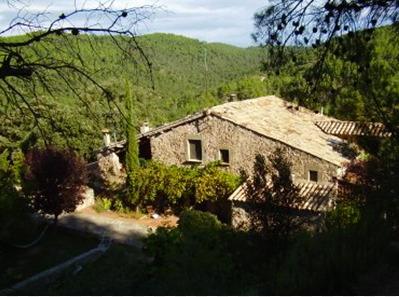
Cal Cases is a community of 29 people, women, men, children and young people located 8 km from Santa Maria d’Oló (Moianès).
Biography
Cal Cases is a community of 29 people—women, men, children and young people—located 8 km from Santa Maria d’Oló (Moianès). It is a 17-hectare estate with a main farmhouse containing shared spaces and 14 diverse private areas. The project was founded in 2007 and is the first housing co-operative under a right-of-use agreement in the Spanish state; they are leaders in defending this housing model, especially in rural areas. The project also prioritises self-management, food and energy sovereignty, ecological building and networking with other transformative projects in the territory.
More information HERE
Can Parera
Sant Pere de Vilamajor
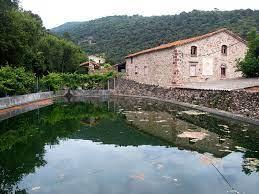
A farmhouse in the Montseny natural park that prioritises community living and transformative productive projects.
Biography
Can Parera de Canyes is a masia (Catalan farmhouse) in the Montseny natural park, 3 kilometres from Sant Pere de Vilamajor, home to 13 adults and 7 kids. The community living model features diverse, non-nuclear family arrangements and shared spaces for all. They share the house, food, care and child-rearing across the community. The estate includes about 2 hectares of land and 900 m² of buildings open to local people with projects for social transformation in the wider community.
More information HERE.
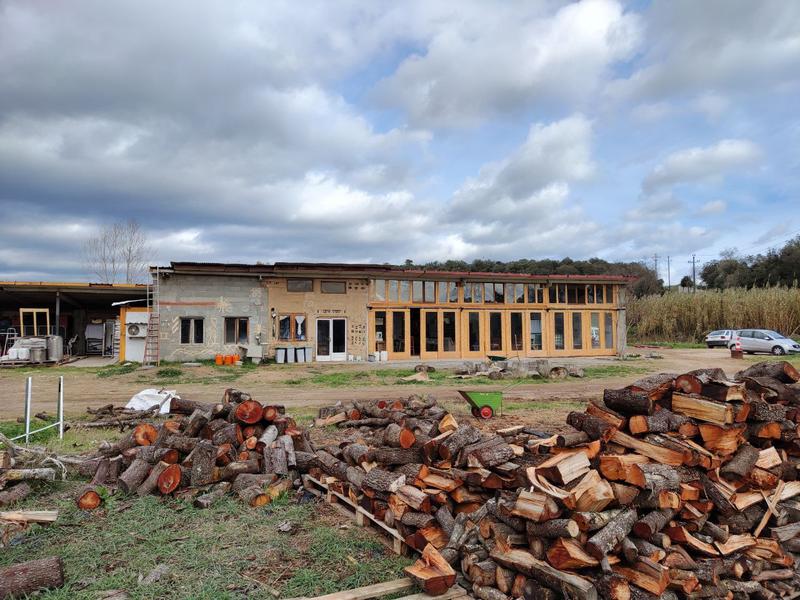
Can Tonal
Sant Antoni de Vilamajor
Can Tonal is a community project integrating living space, production and self-sufficiency, and transformative community social space.
Biography
Can Tonal de Vallbona is a social and community space project that began in 2014. It occupies a one-hectare site that was once an abandoned farm on the outskirts of Sant Antoni de Vilamajor, Baix Montseny. The estate has now been rebuilt with diverse community facilities: production workshops, carpentry, meeting spaces and shared kitchen, gym, vegetable gardens, greenhouse and more. The space and its facilities are managed through communal culture, with assemblies and community participation spaces, and with an outward-facing approach.
The social project has two main pillars: Vallbona Suport Mutu (mutual aid): a self-sufficiency collective of over 70 members and collaborators, and Community space: the shared space is open for events serving the wider community and for hosting groups and activities organised by third parties who need to use it.
More information HERE.
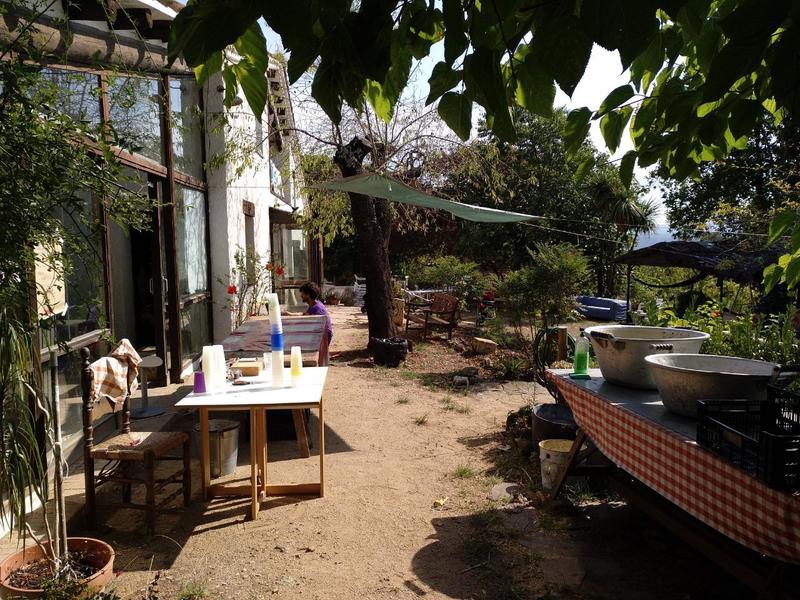
La Tomassa
Campins
La Tomassa is a community living project on the slopes of Montseny made up of 7 adults and 5 children.
Biography
La Tomassa is a community living project that puts care for relationships at the centre and aims to create a way of living that is coherent and fair to the territory. Currently, it is made up of 7 adults and 5 children and is located in the municipality of Campins, on the slopes of Montseny. It is an estate with 3 ha of woodland and farmland, and a main farmhouse that houses common spaces and dwellings, as well as other outbuildings, some in use and others awaiting restoration.
More info HERE.
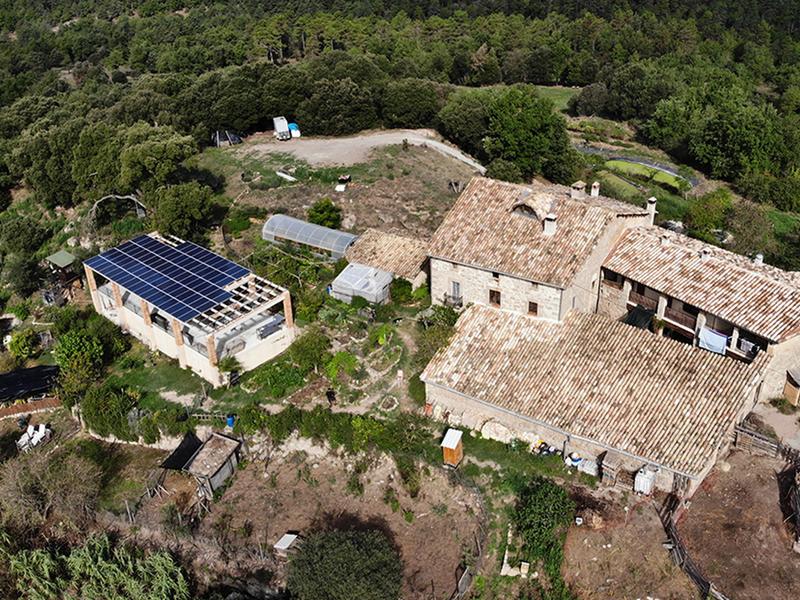
Mas Les Vinyes
Sant Martí d’Albars
Mas Les Vinyes is an intentional community where between 7 and 10 people currently live, including adults and children, located in Sant Martí d’Alba
Biography
Mas Les Vinyes is an intentional community where between 7 and 10 people currently live, including adults and children, located in Sant Martí d’Albars, in the Lluçanès. It is a 25-hectare estate designed on permaculture principles, a field in which they are experts: they organise various permaculture design courses each year on the property itself, advise third parties and have different channels through which they share their work. Moreover, the project places great importance on care within the community, prioritising emotional check-ins, personal growth work and co-operation with other solidarity economy actors in the territory
More information HERE.


